Soviet Workers and the Collapse of Perestroika: The Soviet Labour Process and Gorbachev's Reforms, 1985â1991 (Cambridge Russian, Soviet and Post-Soviet Studies) by Donald Filtzer
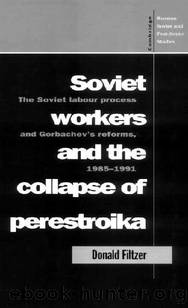
Author:Donald Filtzer [Filtzer, Donald]
Language: eng
Format: epub
Published: 2008-08-27T18:40:00+00:00
Secondly, as we have discussed in the introduction to this chapter and the chapter on worker protests, and take up further in the Conclusion, the group best placed to rise to prominence in the new market economy was the old nomenklatura, in particular high-ranking personnel within the industrial ministries, and enterprise directors. To the extent that privatization was already beginning to take place during the final phase of perestroika, these people assumed control over the newly privatized means of production precisely through the monopolistic - both in a political and economic sense - structures of the old command system. In a shortage economy this could have only one result: the drive to maximize revenues and personal wealth without any impetus towards dynamic innovation, modernization, or development of the productive forces. The supply crisis was merely an expression of this tendency, which manifested itself more fully after the collapse of the Soviet Union and the scramble for ownership under El'tsin's market reforms.
Download
This site does not store any files on its server. We only index and link to content provided by other sites. Please contact the content providers to delete copyright contents if any and email us, we'll remove relevant links or contents immediately.
| Anthropology | Archaeology |
| Philosophy | Politics & Government |
| Social Sciences | Sociology |
| Women's Studies |
The Secret History by Donna Tartt(19480)
The Social Justice Warrior Handbook by Lisa De Pasquale(12300)
Thirteen Reasons Why by Jay Asher(9135)
This Is How You Lose Her by Junot Diaz(7061)
Weapons of Math Destruction by Cathy O'Neil(6487)
Zero to One by Peter Thiel(5955)
Beartown by Fredrik Backman(5952)
The Myth of the Strong Leader by Archie Brown(5632)
The Fire Next Time by James Baldwin(5596)
How Democracies Die by Steven Levitsky & Daniel Ziblatt(5338)
Promise Me, Dad by Joe Biden(5238)
Stone's Rules by Roger Stone(5196)
A Higher Loyalty: Truth, Lies, and Leadership by James Comey(5092)
100 Deadly Skills by Clint Emerson(5034)
Rise and Kill First by Ronen Bergman(4908)
Secrecy World by Jake Bernstein(4897)
The David Icke Guide to the Global Conspiracy (and how to end it) by David Icke(4856)
The Doomsday Machine by Daniel Ellsberg(4632)
The Farm by Tom Rob Smith(4614)
